Transcript
Announcer:
You’re listening to NeuroFrontiers on ReachMD, and this episode is supported by UCB. Here’s your host, Dr. Brian McDonough.
Dr. McDonough:
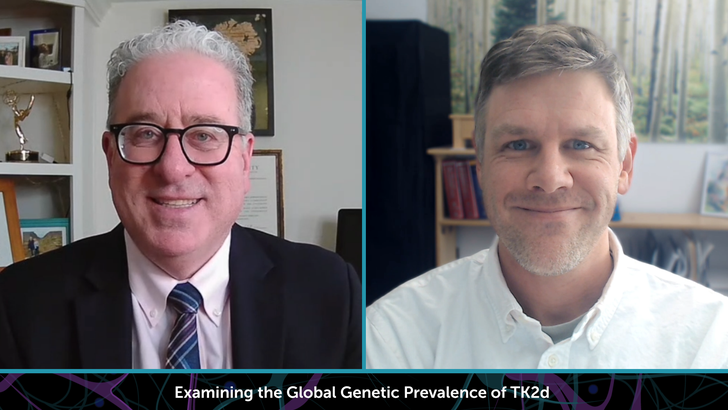
Welcome to NeuroFrontiers on ReachMD. I'm Dr. Brian McDonough, and joining me to discuss emerging insights into the global genetic prevalence of thymidine kinase 2 deficiency, or TK2d for short, is Dr. Austin Larson. He's an Associate Professor of Pediatric Clinical Genetics and Metabolism at the University of Colorado Anschutz. He recently presented these findings at the 2026 Muscular Dystrophy Association Clinical and Scientific Conference. Dr. Larson, thanks for being here today.
Dr. Larson:
Thanks for having me.
Dr. McDonough:
To start us off, Dr. Larson, what motivated you to re-evaluate the prevalence of TK2d, and what gaps in our understanding were you hoping to address?
Dr. Larson:
Well, TK2d is a mitochondrial disease. It's a progressive condition. And treatment was recently approved by the FDA and the EMA. So in the setting of a condition with a disease-modifying therapy, there's more motivation to understand the breadth of different presentations of the condition. It's also a condition that doesn't have specific biomarkers other than genetic testing. So understanding the genetic landscape of the condition is really critical to making sure that patients are diagnosed in a timely fashion and that they have access to the treatment at a time that it would have the most impact on the course of their disease.
Dr. McDonough:
If we take a closer look at your methods, how did combining clinical literature with large genomic databases strengthen the reliability of your prevalence estimates?
Dr. Larson:
Well, TK2d is a recessive condition, meaning that an individual would have to inherit a pathogenic variant or a mutation from each parent in order to be affected by the condition. It's also a condition that we think meets the criteria for what we call Hardy-Weinberg equilibrium, meaning that the carrier frequency in the population should be reflective of the incidence of the condition at birth.
So for a recessive condition that meets the assumptions of Hardy-Weinberg equilibrium, you can use the carrier frequency in the general population as a way to estimate the prevalence of the disease in the population. Now, the individuals with the condition are not going to be present in these databases in general, so we can't directly identify genetically diagnosed individuals in population databases, but we can infer the prevalence or the incidence of the condition based on the carrier frequency.
Dr. McDonough:
For those just tuning in, you're listening to NeuroFrontiers on ReachMD. I'm Dr. Brian McDonough, and I'm speaking with Dr. Austin Larson about his research on the global genetic prevalence of TK2d.
Turning now to your findings, Dr. Larson, can you walk us through the prevalence estimates and how we should interpret them?
Dr. Larson:
So what we found is that the predicted incidence at birth of TK2d varies widely across different populations around the world. So the overall estimated global prevalence of TK2d is a lower-bound estimate is 0.34 per million individuals, and an upper-bound estimate is 2.82 per million individuals. And that's based on lumping all the populations around the world together.
But if we drill in on individual genetic ancestries, we can see some significant differences between different groups. So we found that when we look at the Admixed American population—those are individuals that generally self-identify as Hispanic or Latino; in the population genetics literature, that is referred to as Admixed American genetic ancestry—we found that the lower-bound estimate of prevalence is 2.8 per million individuals, and the upper-bound estimate is 13 per million individuals. In the African and African-American subpopulation, we found an estimate between 0.36 and 8.2 per million individuals. In the South Asian population, the predicted incidence at birth of TK2d is 0.27 to 5.15 per million individuals. And in the Finnish subpopulation, we found that it is 3.2 to 4.3 per million individuals.
So the takeaway from that is that there's significantly different prevalence across different subpopulations. This does correspond with what we hear from clinicians who are caring for patients with TK2d in the United States, which is that a significant proportion of their diagnosed patients self-identify as Hispanic or Latino. So that clinical experience is backed up by the genetic prevalence data that we're presenting here.
Dr. McDonough:
And when it comes to population-specific differences, where are we seeing the highest burden?
Dr. Larson:
The underlying data source that we're using here is called the gnomAD database. So that is some of the basic infrastructure of genetics. So we use the gnomAD database just to understand how common specific genetic variants are. That allows us as geneticists to understand what's likely just a benign variant in the population versus what's has more potential to be disease causing. So in the gnomAD database, they've used statistical techniques to separate individuals in the database into different genetic ancestries, and that largely corresponds with self-reported ancestry when you ask individuals where their relatives are from or what their ancestry is. But it is a statistical calculation based on genetic variants in the genome.
So when we looked at different populations that are separated that way, we found that there was quite significant differences in the incidence of TK2d in different populations around the world. So the populations that stand out as potentially having higher prevalence than the worldwide average in particular is the Admixed American population. And we found that both when we're looking at just proven pathogenic variants in the gene as well as predicted pathogenic variants in the gene, the prevalence of TK2d or the incidence at birth is likely significantly higher than the worldwide average.
Dr. McDonough:
Now, which variants seem to be driving disease burden in these populations, and how might these findings refine our assessment of disease risk?
Dr. Larson:
Yeah, so there are a couple ways that information is useful. So one of the outcomes of this study was to predict which pathogenic variants are most likely to be present in individuals affected by the condition. So there's two scenarios that I'd like to talk about.
One is the scenario where there are pathogenic or likely pathogenic variants. And in that scenario, it's particularly useful to define which variants are the major drivers of the diagnosis in the population because then we can start to make genotype phenotype correlations. So as we determine what are the most prevalent variants in affected individuals, then we can look to see what are the clinical correlates of specific mutations or specific pathogenic variants? Are they likely to be later onset or more slowly progressive? Or are they likely to be correlated with more severe earlier onset and more rapidly progressive disease? And that then can inform treatment decisions by providers once that additional research is done to make those genotype phenotype correlations.
The other way that this is helpful is that we provided both a lower bound and an upper bound estimate of the incidence of the disease based on carrier frequency. The upper bound estimate is determined by including what are called variants of uncertain significance. But the variants of uncertain significance bucket is very wide. So that goes anywhere from a 5 percent probability of being clinically significant to a 95 percent probability of being clinically significant. And it turns out we can do better than that. So within the variants of uncertain significance, we can hone in on those variants of uncertain significance that are very close to that threshold of being likely pathogenic. And when we include some of those, that's how we get the upper bound estimate for these individual populations. And when we figure out which of those suspicious variants of uncertain significance and those near-threshold variants of uncertain significance are prevalent in the population and are driving that spread between the lower-bound estimate and the upper-bound estimate, that then gives us a target for specific variants that would be the highest leverage to be able to adjudicate and determine the significance of them. So then any future genetic testing has higher sensitivity and more definitive answers once we can work our way through those variants of uncertain significance and be able to definitively adjudicate them as likely pathogenic.
Dr. McDonough:
Finally, Dr. Larson, as we think about translating this into clinical practice, how might these findings shape our approach to diagnosis, general testing strategies, or even newborn screening efforts?
Dr. Larson:
So there are programs around the world that use genomic testing as the platform for newborn screening. Those are all in the realm of research, so those are not equivalent to the state newborn screening programs that are present in all 50 states and in many other countries, but they're meant as an adjunct to the state newborn screening that has a much broader scope. So genomic newborn screening has the potential to identify many more conditions that are potentially treatable.
In order to use genomic newborn screening, we need to have a really refined idea of the genetic architecture of a particular condition, meaning if we identify a specific genetic variant on genomic newborn screening, we need to be able to give a definitive answer, not an uncertain answer. So a study like this that looks at all of the potential diagnostic variants in a particular gene—in this case, TK2—has the potential to, in the future, facilitate genomic newborn screening and make that technique more sensitive and have the ability to capture more of the affected individuals on that test. So this is a long-term project; it's very early days of genomic newborn screening. But this is some of the work that will go into making that a more effective technique in terms of clinically available testing right now.
For geneticists, metabolic geneticists, neurologists, neuromuscular specialists, and other individuals that are trying to identify rare diseases in individuals that present with muscle weakness, gross motor delay, or other symptoms that are compatible with a genetic, neuromuscular, or mitochondrial condition, this study will eventually feed information forward that will improve the interpretation of whole genome sequencing that's ordered on a clinical basis, panel tests, and other clinically available genetic testing.
And then lastly, by identifying the most prevalent disease-causing variants, this gives us a target for working on genotype-phenotype correlations and figuring out which specific genetic variants are likely to be associated with later-onset versus earlier-onset disease, and then eventually have that information feed back into treatment decisions that are being made by providers.
Dr. McDonough:
Well, that's a great comment for us to think on as we come to the end of today's program. I want to thank my guest, Dr. Austin Larson, for joining me to share the important findings on the global genetic prevalence of TK2d. Dr. Larson, it was great having you on the program.
Dr. Larson:
Thanks for the opportunity, I appreciate the invitation.
Announcer:
This episode of NeuroFrontiers was supported by UCB. To access this and other episodes in our series, visit NeuroFrontiers on ReachMD.com, where you can Be Part of the Knowledge. Thanks for listening!